skip to main |
skip to sidebar
 Insanely lush Botanical Gardens behind the Ex-Convent of Santo Domingo.
 A portrait of Porfirio Diaz. He presides over the transition of artifacts from Industrial and Contemporary Oaxaca.
 A clothes wringer brought over by the Spanish.
 Village elders of the village (Tlahui) that Alex lived in in 1992 when he taught English for 6 months. He thinks the guy in front might be Floriberto, the man who created the program for his village.
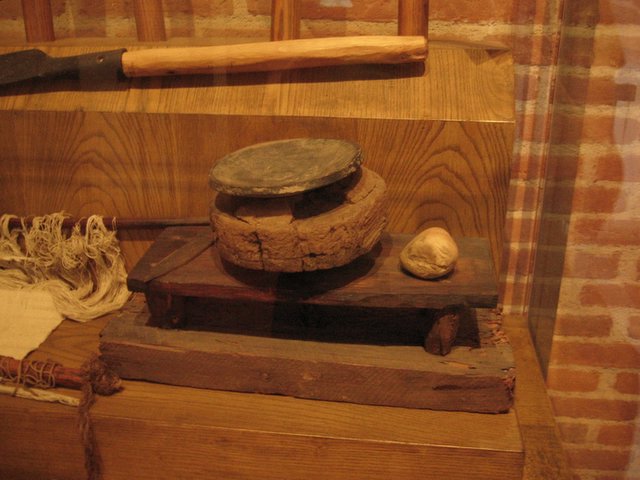
 A pottery wheel. It hasn't changed much in today's Oaxacan pottery.
This was a gorgeous day. Sunny and hot, and I had a glass of fresh squeezed tangelo juice that was perfect. This site is less physically demanding to get about in than Monte Alban, at least for a weakling like me.
Here's a good site giving an overview of the history of the ruins. The little church market in great, too. There are merchants selling ices made with juice and Mezcal (the famous local liquor). Alex wanted just Mezcal and negotiated for few ounces at one of the ice stands. When I saw him with it, I said "Buying liquor from the ice cream man...that's a new low." A couple behind me gasped and started laughing. Which was funny. But it made me realize that I'd come to think of English speaking as a private code. I soon realized this isn't really the case. Tons of people speak English in Oaxaca. They just think it's cool if tourists speak Spanish and will address you in Spanish if you speak Spanish to them. This left me at a disadvantage since Alex's Spanish is almost totally fluent. People would get done talking to him, and turn to me and fire away...little knowing that my Spanish would make a three year old laugh.
This would always prompt big suprised expressions of disbelief that I could be so totally without Spanish when Alex's was so good. People were too polite to say so, of course. Needless to say, I picked up a few books to learn myself up. I understand a lot of conversation, but my pronuciation is terrible, and therefore I lack confidence. (This isn't helped by my having taken 4 years of high school French. I transpose expressions between the two languages constantly.)
A primo example of this was the day we visited Tierra Quemada Ceramica. One of the artists was there to tend the gallery and when he heard that I was a ceramics artist he got really excited (I think it was Omar Hernandez). He pulled out some photo albums and I was delighted to see and hear all about the process that his fellow village artists use to make their ceramics. He showed us the pit firing kiln used with wood and another with horse dung. He talked about the clay and how they processed it from a river bed and then buried it to age in the village to get better quality. He showed pictures of a raku firing he and his buddies had done with propane tanks and a tamale oven. Naturally this was all going on in Spanish but I was following along almost perfectly because he's talking pottery.
He started trying to explain to me how the texture is made on some of the ceramics pieces and he stopped at the puzzled look at my face. He said to Alex "She doesn't speak Spanish?" in Spanish. This phrase had become really familiar to me at this point so I tried to save face with "Yo...habla...ceramica!" We laughed.
Some ceramics vocab words for the potter:
barro: clay
horno: oven/kiln
tambo: tamale oven used for raku firing
gereta: glaze (but may be particular to Atzompa).
The texture method used on some of the ceramics is done by pressing the dried out fibers of nopales (an edible cactus) into wet clay. It gives a lacey skeletal pattern that is very cool. They rub oxides into it before firing it to bring out the patterns. I liked this gallery the best of all the ceramics we saw. I like the traditional stuff, too, but it's cool seeing artists trying new approaches.
MPK
 Buildings like these were living quarters for the priests. The roofs of all these buildings were wood or thatch and have disappeared with the years.
 Aspect showing the walls painted red with iron oxides You can also see the patterned stone panels. Our guide told us that the patterns represent different weather conditions.
 Underground tomb under the temples of Mitla. Only priests or kings were buried here. It's accessed by a tunnel a little larger than this laptop, a claustrophobe's delight!
 Back of Mitla temple structure.
 The Catholic Church built with the stones of the sacred Mitla temples, thus making them "ruins".
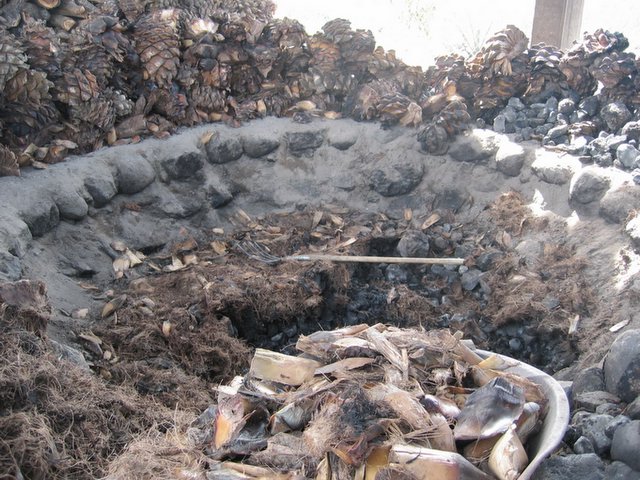
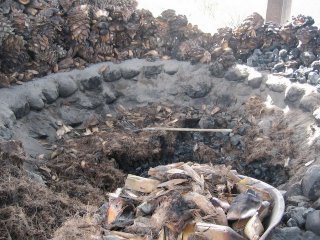 The giant pine cone looking objects around the pit are agave hearts, the main ingredient in Mezcal.
 Agave hearts being pulped.
 Mezcal still...mmm...small batch.
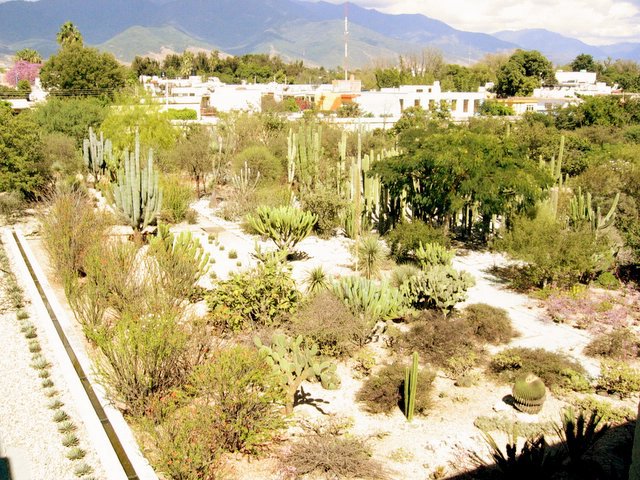 Insanely lush Botanical Gardens behind the Ex-Convent of Santo Domingo.
 A portrait of Porfirio Diaz. He presides over the transition of artifacts from Industrial and Contemporary Oaxaca.